
3T wide-bore MRI in Laurel, MDSharper MRI, with room to breathe.
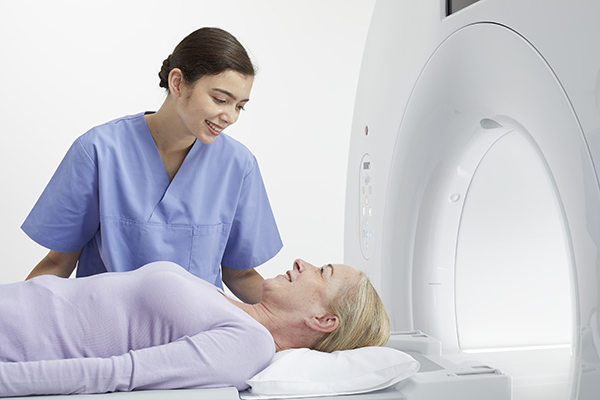
Our 3 Tesla wide-bore MRI captures fine detail in the brain, spine, joints and soft tissues, in a scanner with a wider opening and calming touches for anyone who dreads “the tube.” Board-certified radiologists read every study.
- Time on the table20–60 min
- RadiationNone
- PreparationUsually none
- Results to your doctor24–48 hours
Why choose us
Why patients choose our 3T MRI
Stronger
Twice the magnetic field strength of a traditional 1.5T MRI, for more signal and finer detail.
Wider
An opening about 18% wider than traditional systems, for more comfort and less claustrophobia.
Faster
The stronger magnet allows shorter scans without giving up image quality.
Sharper
Crisper images give radiologists more confidence in what they see.
What it shows
What an MRI can help diagnose
Your doctor may order an MRI to look closely at soft tissue that X-ray and CT show less clearly. Common reasons include:
- Brain & nervesEpilepsy, multiple sclerosis, headaches, brain tumors and other neurological conditions.
- SpineHerniated discs, spinal stenosis, degenerative disc disease and nerve compression.
- Joints & musclesLigament and cartilage tears and muscle injuries in the knee, shoulder, hip and more.
- ProstateMultiparametric prostate MRI to detect and stage cancer and to guide biopsy.
- AbdomenThe liver (including cirrhosis), pancreas and bowel, such as inflammatory bowel disease.
- PelvisFibroids, ovarian cysts and bladder conditions.
Why 3T matters
More signal, more detail, more confidence
Higher field strength means more detail. In a study of 74 people with focal epilepsy, 3T MRI found the brain abnormality in 65 patients, compared with 55 on 1.5T MRI, and characterized it correctly more often.
Source: American Journal of Roentgenology study, reported by ScienceDaily (2008)
Before your exam
How to prepare
Your appointment confirmation includes exact instructions for your exam. In general:
- Tell us about implantsPacemakers, defibrillators, cochlear implants, nerve stimulators, aneurysm clips, insulin pumps and any metal fragments. Many devices are MRI-safe or MRI-conditional, but we need to check before your scan.
- Dress simplyWear comfortable clothes without metal (no zippers, snaps or underwire) and leave jewelry at home. You may be asked to change into a gown.
- Eat as usualMost MRI exams need no fasting. Some abdominal exams do, and we will tell you when you book.
- Mention contrast concernsIf your exam uses contrast, tell us about kidney disease, prior contrast reactions or pregnancy.
Comfort comes first
- Soft ambient lighting and noise-reducing headphones
- A wider bore, so you are not shoulder-to-shoulder with the scanner
- Technologists trained to talk you through every minute
- Flexible scheduling, with same-day or next-day times often available
Bring your doctor’s order, photo ID and insurance card. Completing your patient forms ahead of time speeds up check-in.
Schedule online (opens in a new tab)Is a 3T MRI better than a 1.5T MRI?
A 3T magnet is twice as strong as a 1.5T magnet. That extra signal produces sharper, more detailed images and can shorten scan times, which is especially helpful for the brain, spine, joints and prostate. Your radiologist chooses the protocol that best answers your doctor’s question.
What if I am claustrophobic?
Our wide-bore scanner has a roomier opening than traditional MRI machines, and we use soft lighting, headphones and constant contact with your technologist. If you are very anxious, ask your doctor ahead of time whether a mild sedative is right for you, and arrange a ride home if you take one.
Can I have an MRI with a pacemaker or other implant?
Sometimes. Many modern implants are MRI-conditional, meaning they can be scanned under specific settings. Tell us the make and model when you book so our team can confirm it is safe before your appointment.
Will I need contrast?
Only some MRI exams use contrast, a dye given through an IV that makes certain tissues stand out. Your doctor’s order tells us whether it is needed. If it is, we may ask about your kidney function and any prior reactions.
How long does an MRI take?
Most exams take 20 to 60 minutes on the table, depending on the body part and whether contrast is used. Plan a little extra time for check-in and safety screening.
More imaging
Other services at Align
Low-dose CT
Cross-sectional images in minutes, with low-dose protocols and a spacious wide-bore design.
Learn moreHigh-resolution ultrasound
Real-time, radiation-free imaging of organs, vessels, muscles and lumps with exceptional clarity.
Learn moreDigital X-ray
Quick, low-dose digital images of bones, joints and the chest, sent straight to the radiologist.
Learn moreSchedule your MRI in Laurel
Book your exam online in a few minutes, or call and talk with a real person at (240) 499-2863. Same-day or next-day appointments are often available.